Table of Contents
- Why Estate Cleanouts in Montana Are Different
- Why Sorting Through a Loved One’s Belongings Is Harder Than You Think
- A Proven Framework for Tackling the Overwhelming Task of Sorting
- Why Attempting Estate Cleanouts Alone Often Costs More in the Long Run
- How Professional Estate Cleanout Services Support Montana Families
- Key Takeaways
The loss of a loved one brings an overwhelming wave of emotions—grief, nostalgia, and the weight of responsibility. For Montana families, settling an estate often means confronting not just the emotional aftermath, but also the physical reality of a lifetime’s worth of belongings. With Montana’s aging population—19.6% of residents are 65 or older—estate cleanouts have become an increasingly common challenge for adult children and executors. Beyond the emotional toll, there are practical pressures: probate timelines, real estate preparation, and the sheer physical labor of sorting decades of possessions. Many families underestimate the complexity, attempting DIY cleanouts only to face injury risks, decision fatigue, and months of delay. This guide walks you through the estate cleanout process in Montana, from understanding your legal obligations under the Montana Uniform Probate Code to implementing efficient sorting strategies. Most importantly, we’ll explore how professional services like Ballistic Junk Removal can transform this daunting task into a manageable, respectful transition—allowing you to focus on honoring your loved one’s memory rather than drowning in logistics.
Why Estate Cleanouts in Montana Are Different
Montana’s unique demographic trends and legal framework create specific challenges for estate settlement that families must navigate carefully.
The Silver Tsunami
Montana ranks among the states with the oldest populations in America. The U.S. Census Bureau reports that 19.6% of Montana residents are aged 65 or older, significantly above the national average. This demographic reality means more families will face estate transitions in the coming decade.
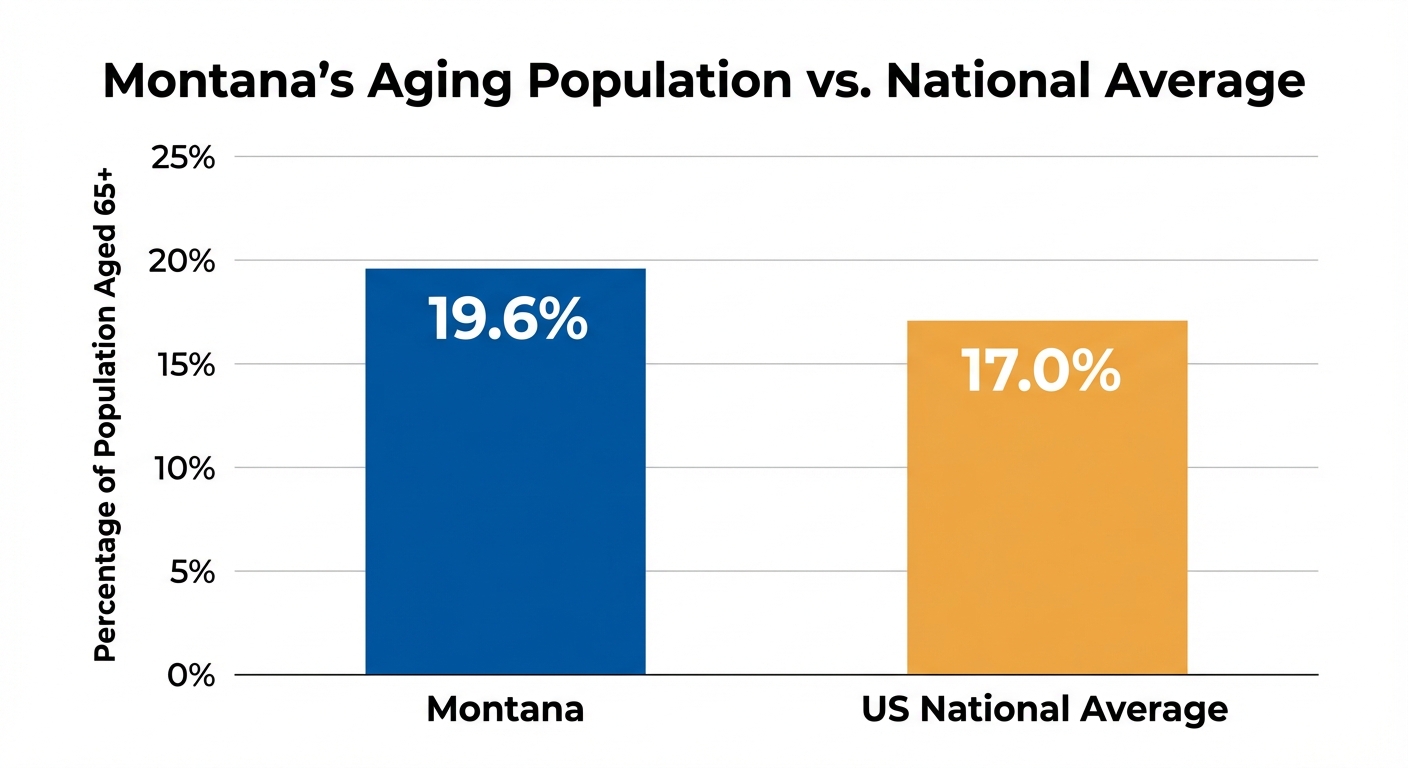
The chart above illustrates just how significantly Montana’s senior population exceeds the national average, emphasizing why estate services are becoming increasingly critical infrastructure for our communities.
Geographic Challenges
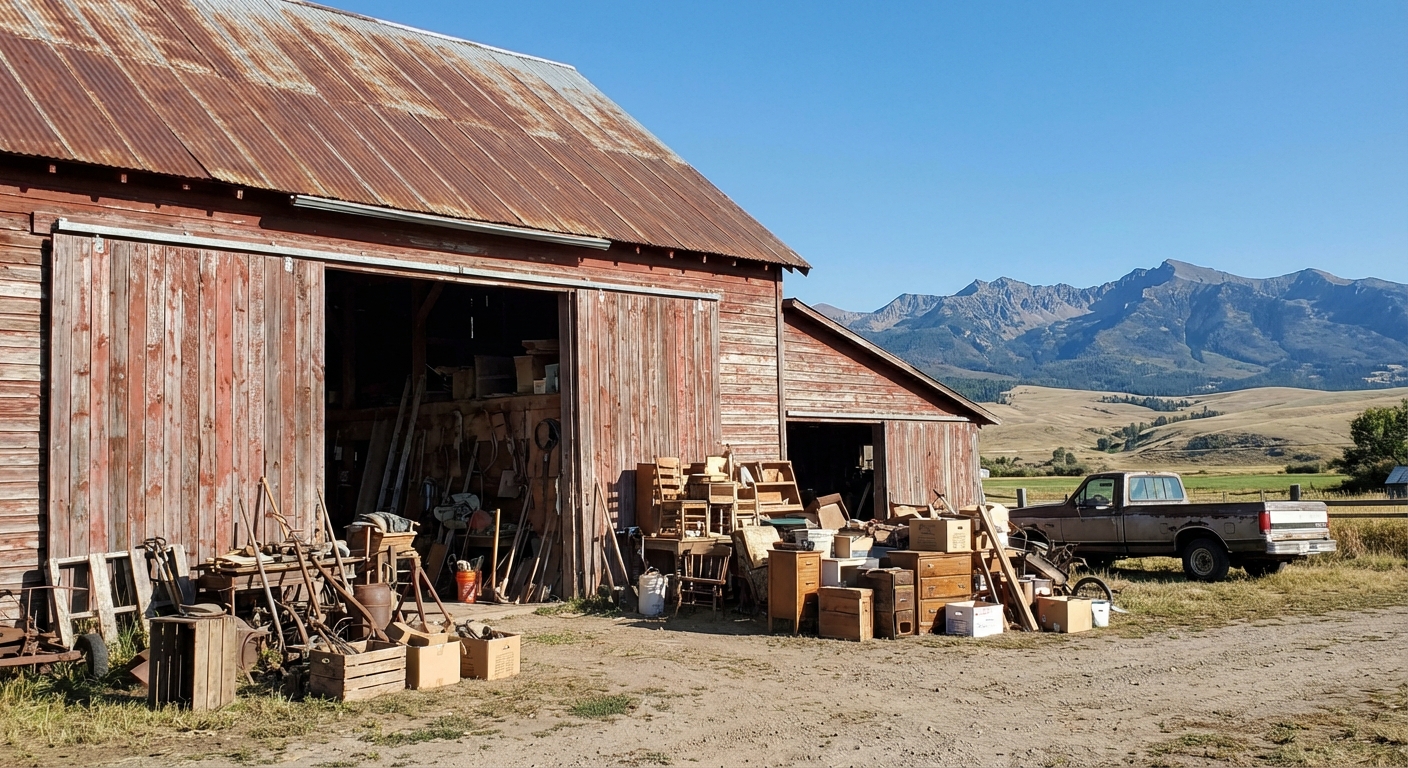
Montana’s rural nature means properties often contain outbuildings, workshops, garages, and vast accumulations of items. Unlike urban estates with limited storage, Montana homes may include decades of farm equipment, outdoor gear, and household goods spread across multiple structures. A single property might have:
- Main residence with basement and attic storage
- Detached garages filled with tools and automotive equipment
- Barns or sheds housing agricultural implements
- Workshop spaces with decades of accumulated materials
Each of these spaces represents hours—sometimes days—of sorting and removal work.
Legal Framework
Under Montana Code Annotated Title 72, the Personal Representative (executor) has a fiduciary duty to efficiently settle the estate, including inventorying and protecting assets. However, the majority of estate contents—furniture, clothing, household goods—are non-probate personal property that must be cleared to prepare real estate for sale. The executor faces competing pressures: thoroughness in asset identification versus speed in property preparation. Understanding what requires legal documentation versus what simply needs efficient removal is critical to meeting probate timelines.
The Financial Clock
Every day a property sits uncleared, the estate incurs holding costs: utilities, property taxes, insurance, and potential maintenance. In Montana’s competitive real estate market, delays in listing can translate to thousands in lost value or additional carrying costs.
Consider this scenario: A typical Montana home carries $300-$500 in monthly holding costs. A three-month delay in clearing and listing the property costs the estate $900-$1,500—often more than professional cleanout services would have charged. Additionally, properties that sit empty face increased risks of weather damage, vandalism, or deterioration that further diminish value.
Why Sorting Through a Loved One’s Belongings Is Harder Than You Think
The psychological burden of estate cleanouts is often underestimated, with grief and decision fatigue creating paralysis that extends the process unnecessarily.

Bereavement Overload
Research published by the National Institutes of Health identifies household dissolution as a primary stressor during mourning. The logistics of death—funeral planning, legal paperwork, and property management—overlap with emotional processing, creating what psychologists call “bereavement overload.” You’re not just managing tasks; you’re managing tasks while your brain is actively processing loss. The cognitive load becomes overwhelming, leading to decision paralysis and extended timelines.
Objects as Memory Banks
Psychologists explain that personal possessions serve as “external memory storage.” Each item—a parent’s favorite chair, handwritten recipe cards, tools from the garage—triggers memories and emotional connections. Discarding these items can feel like erasing the person themselves, leading to decision paralysis. This isn’t weakness or sentimentality gone overboard. It’s a normal human response to loss. The coffee mug your mother used every morning isn’t just ceramic—it’s a physical connection to countless breakfast conversations. Understanding this psychological reality helps explain why estate cleanouts take far longer than anticipated.
The “Just One More Weekend” Trap
Families consistently underestimate the time required for estate cleanouts. What begins as “we’ll handle it ourselves over a few weekends” often stretches into months. Adult children, typically managing careers and their own families, struggle to dedicate the sustained time necessary for thorough clearing. The pattern typically unfolds like this:
- Weekend 1: Tackle the “easy” rooms, become emotionally exhausted after 4-6 hours
- Weekend 2: Life intervenes—someone gets sick, work demands increase
- Weekend 3: Return to find the task even more daunting than remembered
- Weeks 4-8: Sporadic progress with mounting guilt and stress
- Months 3-4: Finally accept professional help is needed
Conflict Among Heirs
Multiple family members involved in sorting can lead to disagreements over item value, sentimental worth, or distribution. These conflicts, rooted in grief and stress, can damage family relationships during an already vulnerable time. One sibling sees “junk that needs to go,” while another sees “Dad’s treasured collection.” These differing perspectives, valid in their own ways, create tension that slows progress and increases emotional strain.
The Case for Neutral Third Parties
Professional services provide emotional distance that family members cannot. They facilitate decision-making without attachment, ask clarifying questions without judgment, and maintain momentum when grief threatens to stall progress.
An AARP study on Swedish Death Cleaning found that 82% of families using professional services reported significant stress reduction, allowing them to focus on memorializing their loved one rather than managing logistics.
A Proven Framework for Tackling the Overwhelming Task of Sorting
Estate cleanouts become manageable when approached systematically. This industry-tested sorting method provides clarity and prevents decision paralysis.
The Four-Category Method
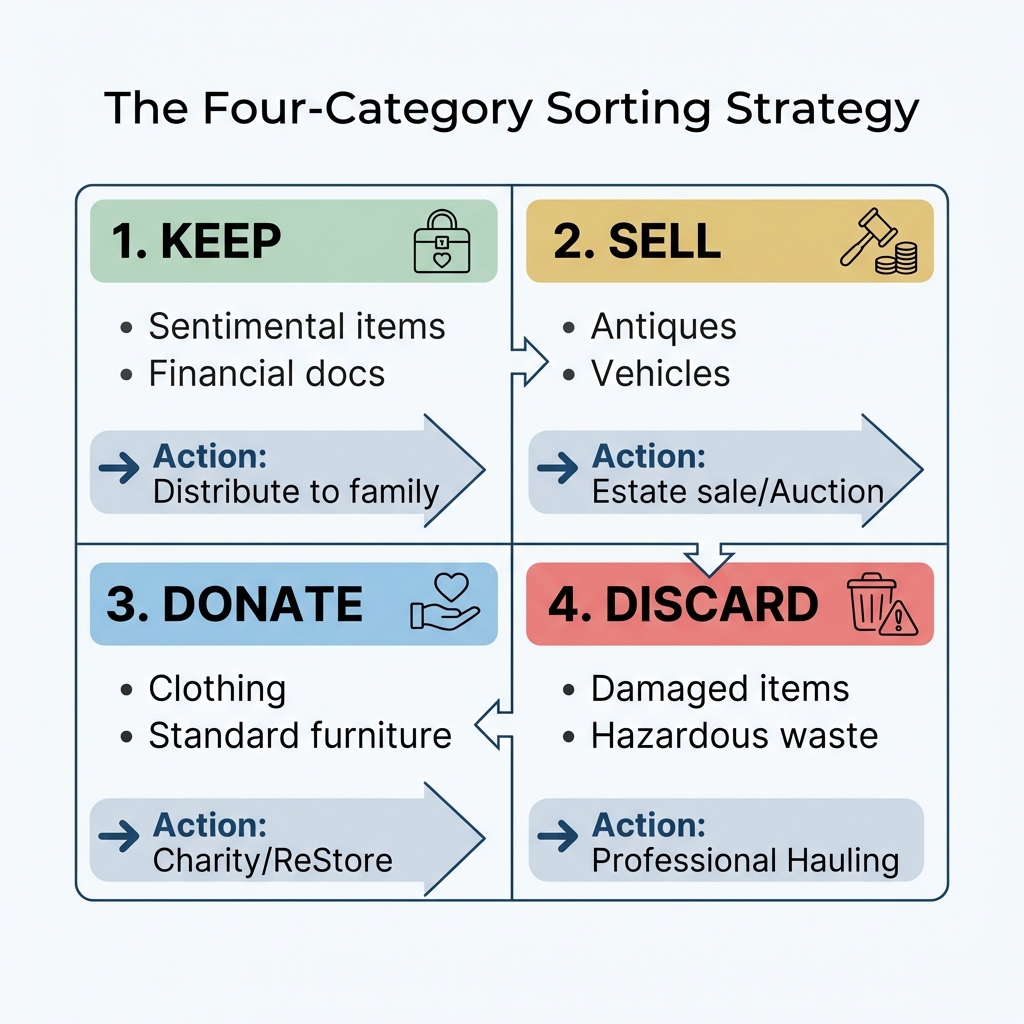
Estate professionals recommend dividing all possessions into four clear categories.
1. KEEP (Family Distribution)
What Qualifies: Sentimental items including photo albums, heirlooms, and jewelry; high-value assets such as art and collectibles; and critical documents including deeds, titles, and financial records.
Action Required: Immediate secure packing and distribution among heirs. Consider climate-controlled storage for items requiring family consensus.
Montana Consideration: For rural properties, identify items of genuine historic or collectible value—vintage Montana memorabilia, quality Western art, antique tools, or Native American artifacts that may require special handling or appraisal.
2. SELL (Estate Sale or Auction)
What Qualifies: Antiques, vehicles, quality furniture, firearms (common in Montana estates), and recreational equipment.
Action Required: Professional appraisal for high-value items. Estate sale companies or online auctions through platforms like EstateSales.net, Craigslist, or Facebook Marketplace.
Timeline Impact: Estate sales require 2-4 weeks of planning. Factor this into your probate timeline. If the property needs to list quickly, selling high-value items individually through online platforms may be faster than organizing a formal estate sale.
3. DONATE (Community Benefit)
What Qualifies: Usable clothing, standard furniture, housewares, books, and working appliances.
Montana Resources:
- Habitat for Humanity ReStore (locations in Billings, Missoula, and Great Falls) accepts furniture and building materials
- Goodwill and Salvation Army for general household goods
- Local churches and community centers often accept specific items for families in need
Tax Benefit: Donations to 501(c)(3) organizations are tax-deductible for the estate. Maintain receipts and itemized lists for tax documentation.
4. DISCARD/RECYCLE (Professional Removal Recommended)
What Qualifies: Damaged furniture, old mattresses, bulk trash, hazardous household waste including paint, chemicals, and batteries, plus non-working appliances.
Why Professional Help Matters: Montana’s Department of Environmental Quality regulates hazardous waste disposal. Improper disposal can result in fines. Professional haulers like Ballistic Junk Removal have established relationships with transfer stations and recycling facilities ensuring compliance.
Environmental Responsibility: The EPA reports that furniture and durable goods contribute over 12 million tons to municipal waste annually. Responsible haulers prioritize recycling and landfill diversion, ensuring your loved one’s estate doesn’t unnecessarily burden Montana’s environment.
Implementation Strategy
| Week | Focus Area | Key Activities |
|---|---|---|
| Week 1 | Initial Categorization | Walk through property, apply colored stickers/labels, identify high-value items, secure critical documents |
| Week 2 | Keep & Sell Categories | Secure valuables, arrange professional appraisals, photograph items for online sales |
| Week 3 | Donate & Discard | Coordinate charity donations, schedule professional removal for bulk waste |
Why Attempting Estate Cleanouts Alone Often Costs More in the Long Run
While DIY cleanouts appear economical, the hidden costs—injury risk, time loss, and market delays—frequently exceed professional service fees.
Physical Risk and Real Injury Potential
Musculoskeletal Injury: The CDC identifies improper lifting as a leading cause of workplace injury, particularly back and shoulder damage. Estate contents include heavy furniture such as sleeper sofas, dressers, and appliances, plus awkward items like mattresses and rolled carpets that require specialized handling.
For adult children—often in their 40s-60s themselves—attempting physically demanding work without proper equipment or training creates serious injury risk. A back injury doesn’t just cause pain; it can mean missed work, medical bills, and long-term mobility issues.
Montana-Specific Hazards: Rural properties may contain decaying structures, wildlife nests in outbuildings, or hazardous agricultural chemicals. Professional teams carry liability insurance and are trained in OSHA-compliant safety protocols.
The Time Opportunity Cost
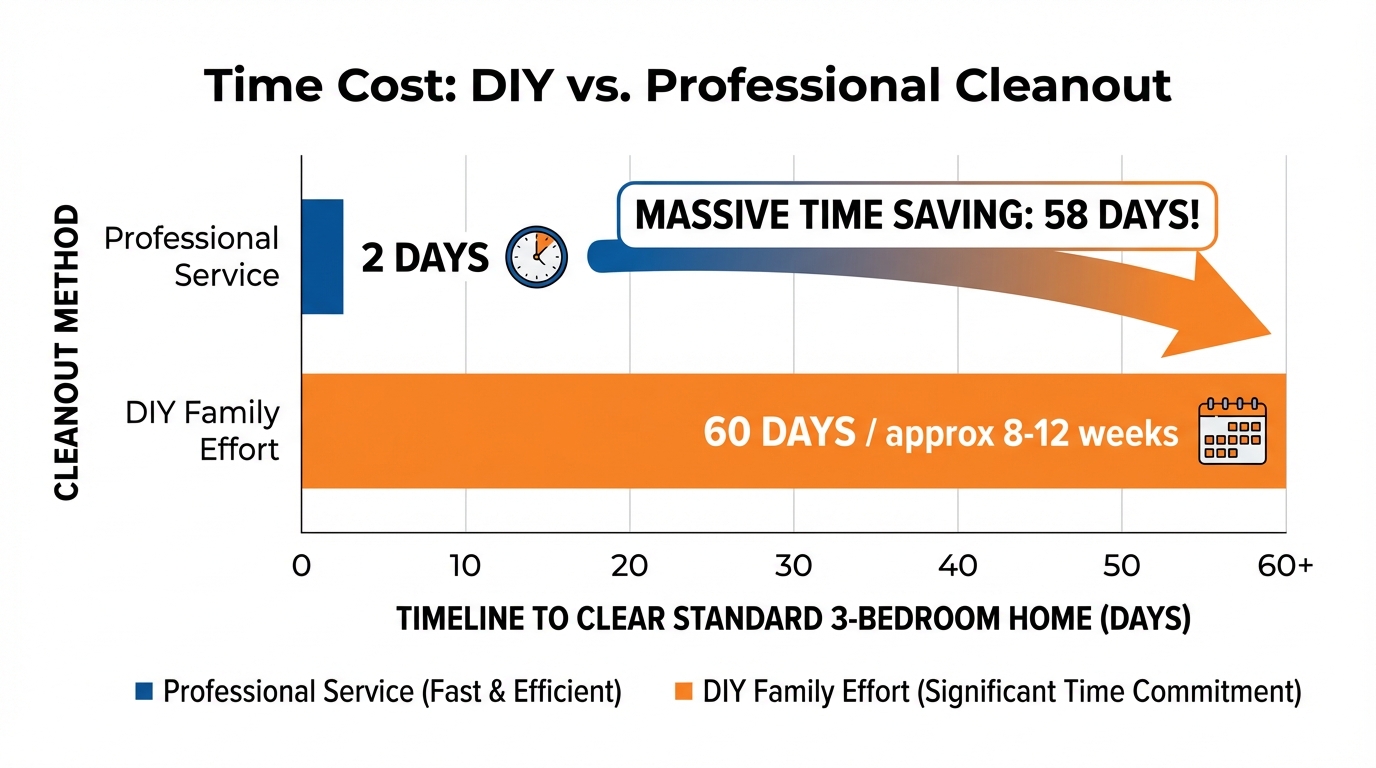
Professional Timeline: A trained team can clear a standard 3-bedroom home in 1-2 days.
DIY Reality: Family-led cleanouts typically span weeks to months, complicated by:
- Work schedules and geographic distance (children living out of state)
- Emotional processing time and decision fatigue
- Multiple trips to donation centers and landfills
- Weather delays (Montana winters can make outdoor work impossible)
Financial Impact: In Montana’s competitive housing market, every month of delay costs the estate:
- Carrying costs: utilities, taxes, insurance ($300-$500/month)
- Market value loss: seasonal fluctuations and changing buyer demand
- Lost opportunity cost: estate funds could be distributed to heirs or invested
A property that could sell in June for top dollar may sit through winter, listing in March at a lower price point due to seasonal market softness.
Logistics Nightmares
Vehicle Limitations: Personal vehicles cannot transport bulk waste. Pickup truck rentals cost $100-$150 per day and still require multiple trips and all physical loading labor.
Dumpster Rental Complexity:
- Requires permits from local authorities
- Limited capacity (a 10-yard dumpster holds approximately 3 pickup truck loads)
- You still provide all loading labor
- Montana rural areas may have limited availability and delivery surcharges
Professional Advantage: Services like Ballistic Junk Removal utilize high-capacity trucks, charge by volume (you only pay for what you use), and handle all loading, transportation, and proper disposal. There’s no permit paperwork, no multiple trips, and no physical strain on family members.
Environmental Compliance
Hazardous Waste Regulations: Montana DEQ strictly regulates disposal of paint, solvents, batteries, fluorescent bulbs, and e-waste commonly found in garages and workshops.
Recycling Access: Transfer stations for mattress recycling, e-waste, and metal scrap vary by county. Professional haulers maintain relationships with compliant facilities statewide, ensuring your estate cleanout doesn’t inadvertently violate environmental regulations.
How Professional Estate Cleanout Services Support Montana Families
Ballistic Junk Removal understands that estate cleanouts are about more than trash removal—they’re about honoring legacies and supporting families during difficult transitions.
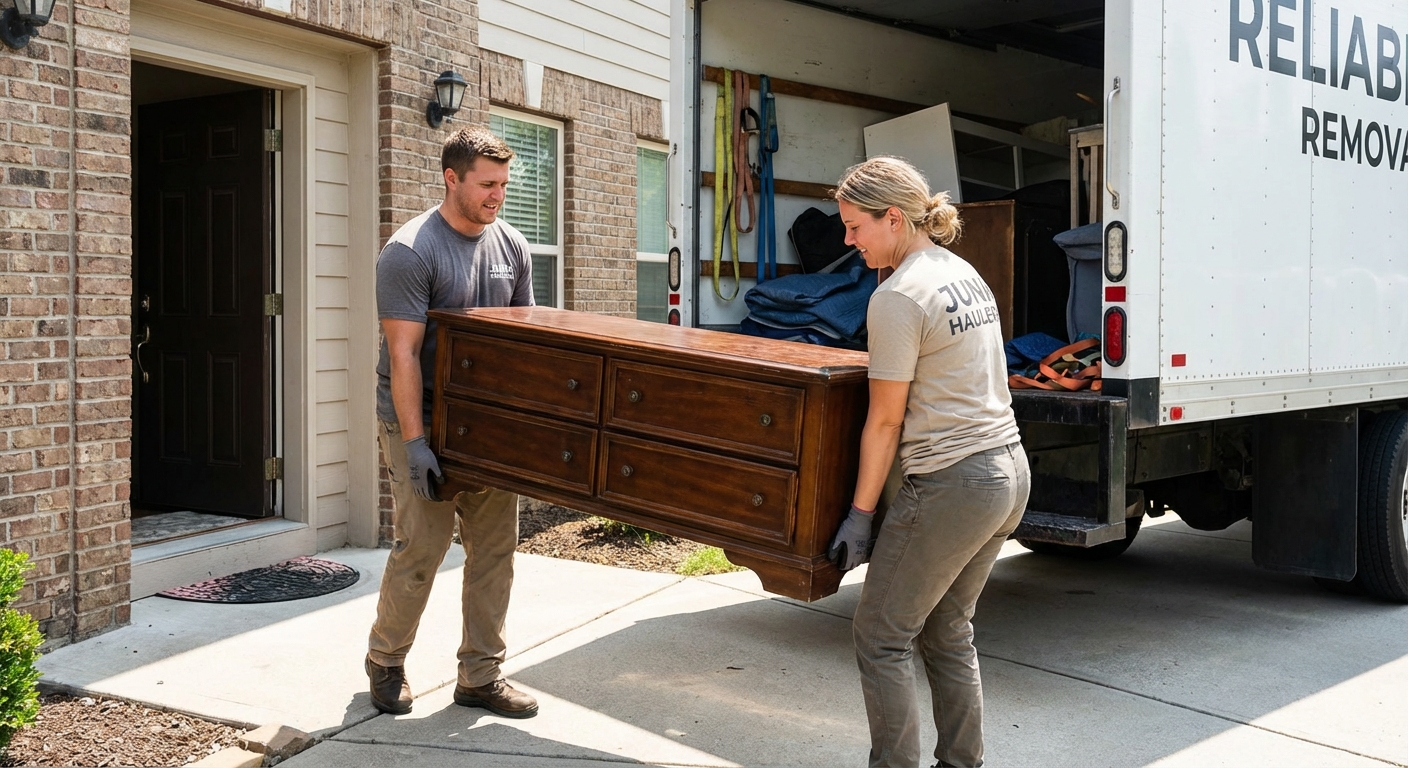
Compassionate, Respectful Service
Understanding the Moment: Professional teams are trained to approach estate work with sensitivity. They understand they’re not just removing “junk”—they’re handling a lifetime of memories.
Flexible Decision-Making: If you’re uncertain about items, professionals can set them aside for later review rather than forcing immediate decisions during emotional moments. This flexibility allows you to maintain control while benefiting from efficient execution.
Comprehensive Service Offering
Full-Property Clearing: From main house to garages, sheds, basements, and attics—complete property preparation for sale or transfer. No space is too challenging or remote. Whether you need garage cleanouts or complete estate cleanouts, Ballistic Junk Removal handles it all.
Donation Coordination: Direct transport to Montana charities and ReStores, with documentation for tax purposes. We handle the logistics so you can claim the deduction without the driving.
Eco-Friendly Disposal: Priority on recycling and landfill diversion, with proper handling of hazardous materials per Montana DEQ guidelines. We sort for recyclable metals, donate usable items, and only landfill what truly cannot be repurposed.
Post-Removal Cleaning: Light broom cleaning after removal to leave the property presentable for showings or final walkthrough.
Supporting Montana’s Real Estate Professionals
Realtor Partnerships: Estate cleanouts are critical for listing preparation. Ballistic Junk Removal works with Montana real estate agents to meet tight listing deadlines, understanding that speed to market affects sale prices.
Efficiency = Market Value: Homes listed quickly after estate settlement sell for an average of 5-7% more than those with extended market delays—helping the estate and heirs maximize their inheritance.
Transparent, Volume-Based Pricing
No Surprises: Pricing based on truck volume used (quarter-load, half-load, full-load), not hourly rates that incentivize slow work. You know the cost before we start.
Free Estimates: On-site assessment to provide accurate pricing before work begins. We walk the property with you, answer questions, and develop a clear removal plan.
Local Knowledge, Statewide Service
Montana-Specific Expertise: Understanding of regional disposal regulations, seasonal access challenges, and local donation networks. We know which facilities accept which materials and the most efficient routes across our service areas.
Statewide Coverage: Serving communities across Montana, from Billings to Billings Heights, Huntley to Shepherd, Laurel to Lockwood, and beyond—including Red Lodge, Columbus, and Roundup. We understand the unique challenges of each region and adapt our service accordingly.
The Bottom Line
Hiring Ballistic Junk Removal isn’t an expense—it’s an investment in your family’s wellbeing, the estate’s value, and your loved one’s dignified transition. By delegating the physical burden, you preserve energy for meaningful work: gathering with family, organizing memorial services, and processing grief.
Key Takeaways
Estate cleanouts in Montana are complex undertakings that blend emotional processing with logistical challenges unique to our state’s aging population and rural geography. While the task may seem overwhelming, understanding your legal obligations under Montana probate law, implementing systematic sorting strategies, and recognizing the hidden costs of DIY approaches can transform this burden into a manageable process.
The most important insight: You don’t have to do this alone. Professional estate cleanout services exist specifically to shoulder the physical demands while you focus on what truly matters—honoring your loved one’s memory and supporting your family through grief.
Whether you’re an executor facing a court deadline, an adult child managing a parent’s estate from out of state, or a realtor preparing a property for listing, Ballistic Junk Removal offers Montana families a compassionate, efficient solution. By combining respectful service with environmental responsibility and transparent pricing, we help you close this chapter with dignity.
Ready to Move Forward with Compassion and Confidence?
If you’re facing an estate cleanout in Montana, let us handle the heavy lifting—literally and figuratively—so you can focus on healing.
References:
- United States Census Bureau – Montana QuickFacts
- Montana Code Annotated Title 72: Estates, Trusts, and Fiduciary Relationships
- National Institutes of Health – Bereavement and Grief in Adults
- Psychology Today – Why It’s So Hard to Let Go of Possessions
- EPA – Durable Goods: Product-Specific Data
- Montana Department of Environmental Quality – Solid Waste Management
- CDC/NIOSH – Ergonomics and Musculoskeletal Disorders
- AARP – The Gentle Art of Swedish Death Cleaning