Table of Contents
- The Perfect Storm: Why Distressed Properties Are Becoming More Complex
- Every Day Counts: The Compounding Financial Drain of Uncleared Foreclosures
- The Critical Distinction: Consumer Junk Hauling vs. Institutional Property Recovery
- EPA, OSHA, and HUD: The Regulatory Framework Governing Extreme Cleanouts
- What Extreme Cleanouts Actually Require: A Phased Approach to Property Recovery
- Key Takeaways
The expiration of pandemic-era eviction moratoriums has normalized property distress events, creating a steady pipeline of REO (Real Estate Owned) properties and court-ordered evictions. For banks, asset managers, and institutional landlords, the financial stakes of delayed property recovery are severe—with every passing week of an uncleared foreclosure costing thousands in holding fees, code violations, and lost revenue opportunities.
Traditional junk removal services are fundamentally unprepared for extreme cleanouts. According to ATTOM Data Solutions, over 357,000 U.S. properties faced foreclosure filings in 2023 alone, representing a 10% year-over-year increase. When hoarding disorder—which affects 2.6% to 6% of the population—intersects with these distressed properties, the operational complexity multiplies exponentially.
This isn’t about hauling away old furniture. Extreme eviction cleanouts require hazardous material sorting, biohazard remediation, structural exposure for damage assessment, and strict adherence to EPA and OSHA regulations. For asset managers bound by HUD timelines and investor expectations, partnering with a specialized property recovery service isn’t optional—it’s a fiduciary necessity.
- Why extreme cleanouts differ fundamentally from standard junk removal
- The hidden financial costs of improper remediation
- How regulatory compliance protects your institution from liability
- What “structural clearing” means in high-stakes property recovery
The Perfect Storm: Why Distressed Properties Are Becoming More Complex

Understanding the statistical reality of property distress and hoarding prevalence helps asset managers anticipate operational challenges and budget appropriately for specialized services.
Foreclosure volume normalization has returned to historical patterns following pandemic protections. ATTOM Data Solutions reports 357,000+ foreclosure filings in 2023, up 10% from 2022. This represents a return to pre-pandemic norms after temporary moratoriums expired, creating a consistent pipeline of properties requiring institutional intervention.
Eviction filing surge mirrors this trend. The Eviction Lab at Princeton University documents that eviction filings in major municipalities have returned to or exceeded pre-pandemic levels, with millions processed annually nationwide. Each eviction represents a potential extreme cleanout scenario, particularly when tenants abandon properties with significant accumulation or damage.
The hoarding factor creates the most significant operational challenge. The American Psychiatric Association estimates that Hoarding Disorder affects 2.6% to 6% of the U.S. population—potentially up to 19 million Americans. For asset managers handling large portfolios, encountering extreme hoarder properties is statistically inevitable, not exceptional. This isn’t a rare “worst-case scenario”—it’s a predictable operational reality requiring systematic preparation.
Operational implications become severe when hoarding intersects with foreclosure. Properties suffer from:
- Hidden structural damage concealed beneath debris
- Biohazard contamination from improper sanitation
- Severe pest infestations that spread to neighboring units
- Code violations that exponentially increase holding costs
What appears to be a straightforward property recovery transforms into a multi-layered remediation project requiring specialized expertise. The convergence of normalized foreclosure rates, sustained eviction volumes, and statistically significant hoarding prevalence creates an environment where institutional property holders must maintain relationships with qualified extreme cleanout specialists. The question isn’t whether your portfolio will encounter these scenarios—it’s how quickly you can deploy appropriate resources when they occur.
Every Day Counts: The Compounding Financial Drain of Uncleared Foreclosures
The measurable financial impact of delayed property recovery extends far beyond obvious holding costs, creating a compounding drain that erodes asset value with each passing week.
Direct holding costs accumulate daily on vacant REO properties. Property taxes, insurance premiums, and utilities continue accruing regardless of occupancy status—typically $600-$1,200 monthly per property depending on location and property size. These costs represent pure capital drain with zero offsetting revenue, making rapid property clearing an immediate financial priority.
Exponential remediation costs represent the most insidious financial threat. Uncleared hoarded properties allow mold, pest infestations, and water damage to proliferate unchecked. A straightforward $2,000 initial cleanup becomes a $15,000+ environmental remediation project within 90 days as biological contaminants spread through HVAC systems, structural water damage advances, and pest populations establish breeding cycles. The financial penalty for delayed action isn’t linear—it’s exponential.
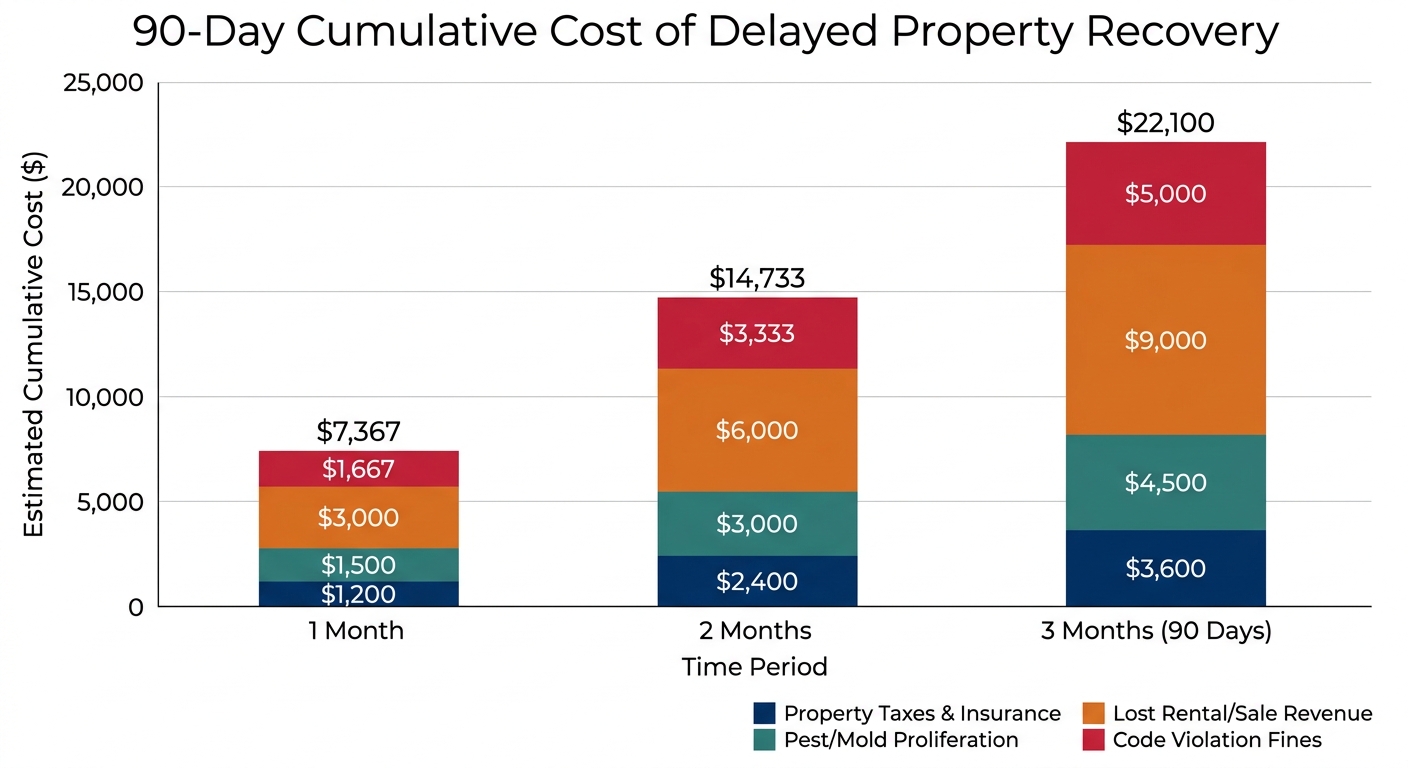
The chart above illustrates how costs compound across four critical categories over a 90-day period. Property taxes and insurance represent the baseline drain, but pest and mold proliferation can reach $4,500 in remediation costs alone. When combined with lost revenue opportunities, a single uncleared property can generate $12,000+ in preventable costs before addressing underlying structural damage concealed by hoarding debris.
Lost revenue opportunity compounds the financial impact. Each month a property sits unmarketable represents $1,500-$3,000+ in lost rental income or delayed sale proceeds. For institutional holders managing quarterly performance metrics, these lost revenue opportunities directly impact portfolio ROI and investor returns. The cost isn’t merely what you spend clearing the property—it’s what you’re not earning while it remains uncleared.
Municipal code violations impose legal and financial consequences. Many jurisdictions impose escalating fines for unmaintained properties, starting at $100-$500 daily and increasing with each inspection cycle. These fines create legal liens that must be cleared before the property can be transferred, adding title complications to existing financial burdens. In extreme cases, municipalities can impose special assessments or initiate condemnation proceedings, triggering catastrophic asset devaluation.
Investor and HUD timeline pressures create contractual urgency. HUD Property Preservation guidelines require mortgagees to secure and preserve properties immediately upon vacancy. Delays trigger compliance issues and potential penalties that extend beyond financial costs to reputational damage with regulatory agencies. For institutional holders, timeline compliance isn’t merely operational—it’s a fiduciary obligation.
The strategic imperative is clear: rapid deployment of specialized property recovery services represents cost avoidance, not cost incurrence.
The Critical Distinction: Consumer Junk Hauling vs. Institutional Property Recovery
Traditional junk removal services lack the training, equipment, and regulatory compliance frameworks required for extreme eviction scenarios. This section establishes why specialized services are not merely “premium” options but operationally necessary.
Scope limitations define the fundamental operational gap. Standard junk haulers are equipped for household furniture, yard waste, and garage cleanouts—scenarios involving accessible, non-hazardous materials that can be safely handled without specialized protocols. They typically refuse biohazards, chemical waste, and hoarded environments requiring PPE. When confronted with extreme eviction scenarios, traditional haulers either decline the job outright or significantly underestimate the complexity, leading to incomplete clearance and abandoned projects.
Hazard identification failures create downstream liability. Untrained crews cannot properly identify or segregate Household Hazardous Waste like paints, solvents, batteries, and chemicals that require EPA-compliant disposal. In hoarded environments where materials are compacted and commingled, proper sorting requires systematic methodology and trained visual identification. Standard haulers lack this expertise, leading to illegal disposal practices that transfer liability directly to the property owner.
Biohazard exposure risks present the most severe operational and legal challenges. Hoarded properties frequently contain:
- Sharps and needles from drug paraphernalia
- Human or animal waste
- Rotting food creating pathogen vectors
- Deceased pests carrying disease
OSHA’s Bloodborne Pathogens Standard mandates specific protocols for handling these materials, including proper PPE such as respirators and puncture-resistant gloves, vaccination protocols for Hepatitis B exposure, and documented exposure incident procedures. Traditional junk haulers lack these protocols entirely, exposing both workers and property owners to disease transmission and regulatory violations.
Liability transfer to asset managers represents the hidden cost of using unqualified vendors. When a standard hauler illegally dumps hazardous materials—whether intentionally to reduce disposal costs or through ignorance of proper protocols—the property owner, not the hauler, faces EPA fines and potential Superfund liability under the Resource Conservation and Recovery Act. OSHA penalties for Bloodborne Pathogen violations range from $15,625 to $156,259 per violation. The initial cost savings of hiring a cheaper vendor evaporates under regulatory scrutiny.
Lack of documentation prevents institutional clients from demonstrating due diligence. Traditional services provide minimal paper trails—often just a receipt for tonnage hauled. Institutional clients need:
- Photographic evidence of property condition before and after clearing
- Itemized removal logs categorizing materials by disposal method
- Disposal certificates from certified facilities
This documentation serves as legal protection in tenant litigation, environmental claims, insurance disputes, and regulatory audits.
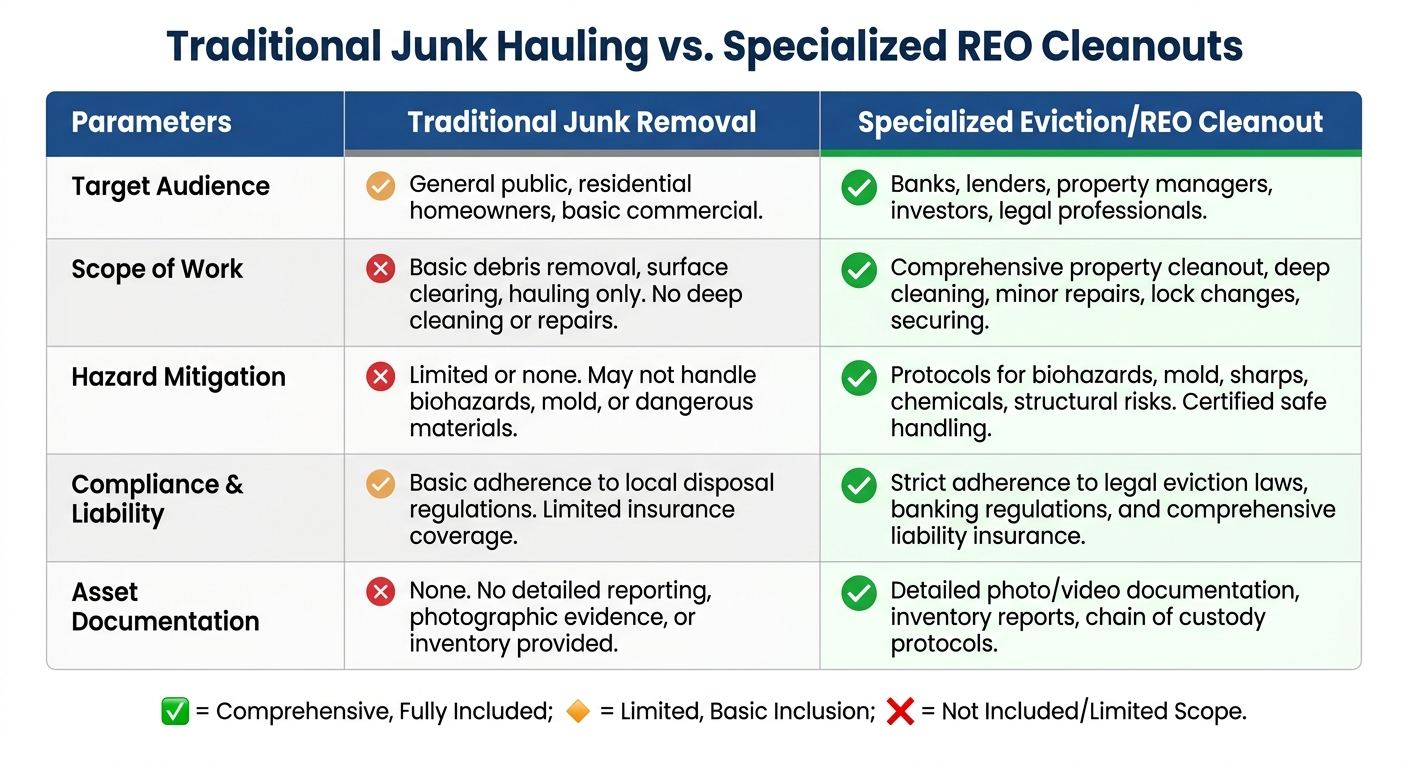
The comparison above illustrates the operational gulf between consumer-focused junk hauling and specialized property recovery services. The target audience, scope of work, hazard mitigation capabilities, compliance standards, and documentation practices differ fundamentally. For institutional clients, selecting a vendor isn’t merely about cost—it’s about operational capability and legal protection.
EPA, OSHA, and HUD: The Regulatory Framework Governing Extreme Cleanouts
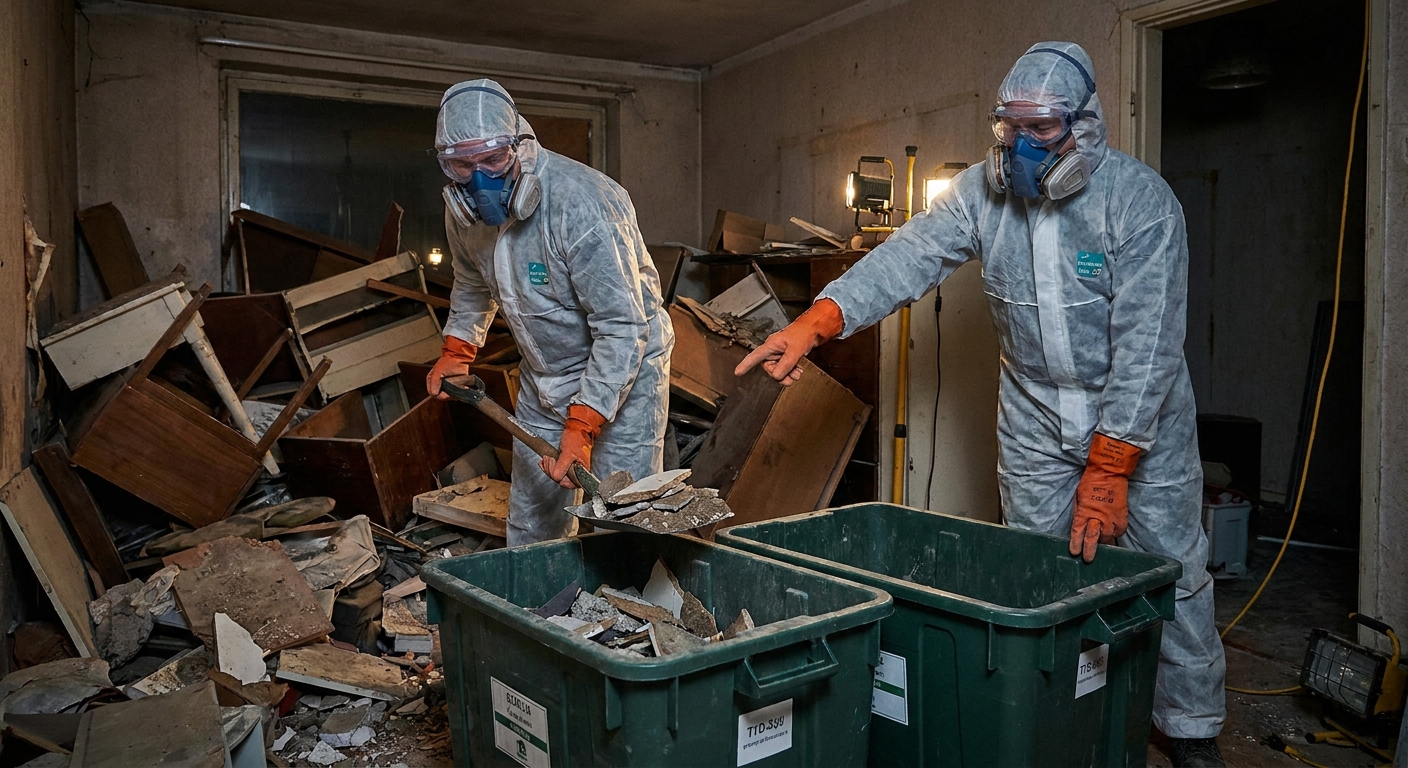
Institutional clients operate in a heavily regulated environment. Specialized cleanout services function as risk mitigation partners, not just service vendors, by maintaining compliance with overlapping federal and local regulations.
EPA Household Hazardous Waste Regulations
EPA Household Hazardous Waste regulations govern the disposal of common household materials that become hazardous in concentrated quantities. Paints, pesticides, motor oil, batteries, and industrial cleaning agents cannot be disposed of in standard landfills due to groundwater contamination risks and toxic vapor emissions. In hoarded properties, these materials accumulate in quantities that trigger commercial hazardous waste handling requirements.
Specialized services systematically sort and route HHW to certified environmental recycling facilities, maintaining disposal manifests that demonstrate regulatory compliance. Illegal dumping violations can result in fines up to $50,000 per day per violation under the Resource Conservation and Recovery Act.
OSHA Bloodborne Pathogens Standard
OSHA Bloodborne Pathogens Standard establishes mandatory protocols for any cleanup involving potential exposure to blood, bodily fluids, or infectious materials. This includes:
- Proper PPE requirements such as NIOSH-approved respirators for airborne pathogen protection and puncture-resistant gloves for sharps handling
- Mandatory Hepatitis B vaccination protocols for employees with occupational exposure
- Documented exposure incident procedures including medical evaluation and post-exposure prophylaxis
Failure to comply can result in OSHA penalties ranging from $15,625 to $156,259 per violation, with repeat violations triggering enhanced penalties and potential criminal referral.
HUD Property Preservation Mandates
HUD Property Preservation mandates create timeline urgency for REO properties. HUD requires mortgagees to secure and preserve foreclosed properties immediately upon vacancy, including:
- Rapid trash-outs and debris removal to enable structural assessments
- Properties must be secured within 48 hours of vacancy notification
- Initial trash-outs completed within 5-7 business days to enable winterization and structural inspections
These timelines aren’t suggestions—they’re contractual obligations with compliance monitoring and potential penalties for non-performance. For institutional holders, selecting vendors capable of meeting HUD timelines isn’t optional.
Liability Chain Considerations
Liability chain considerations determine long-term legal exposure. When asset managers hire non-compliant vendors, they don’t eliminate liability—they inherit it. Under environmental law’s “responsible party” doctrine, property owners maintain liability for improper disposal regardless of contractor actions. The vendor’s bankruptcy, dissolution, or judgment-proof status doesn’t shield the property owner from EPA enforcement.
Specialized services provide documented proof of regulatory compliance through:
- Photographic evidence
- Hazardous material manifests
- Certified disposal receipts
- Detailed timeline logs
This documentation protects institutions from downstream legal exposure.
Documentation as Insurance
Documentation as insurance serves multiple strategic functions:
| Documentation Type | Strategic Function |
|---|---|
| Photographic Evidence | Establishes property condition for insurance claims and damage assessment |
| Hazardous Material Manifests | Demonstrates EPA compliance in environmental audits |
| Disposal Certificates | Proves proper waste routing from certified facilities |
| Timeline Logs | Establishes HUD compliance in servicer reviews |
This documentation functions as legal protection in tenant litigation alleging property damage, environmental claims from neighboring property owners, insurance disputes over coverage applicability, and regulatory audits from HUD, EPA, or OSHA.
What Extreme Cleanouts Actually Require: A Phased Approach to Property Recovery
Extreme cleanouts demand systematic methodology that differentiates professional property recovery from amateur hauling. Understanding this operational framework helps asset managers evaluate vendor capabilities and establish realistic timeline expectations.
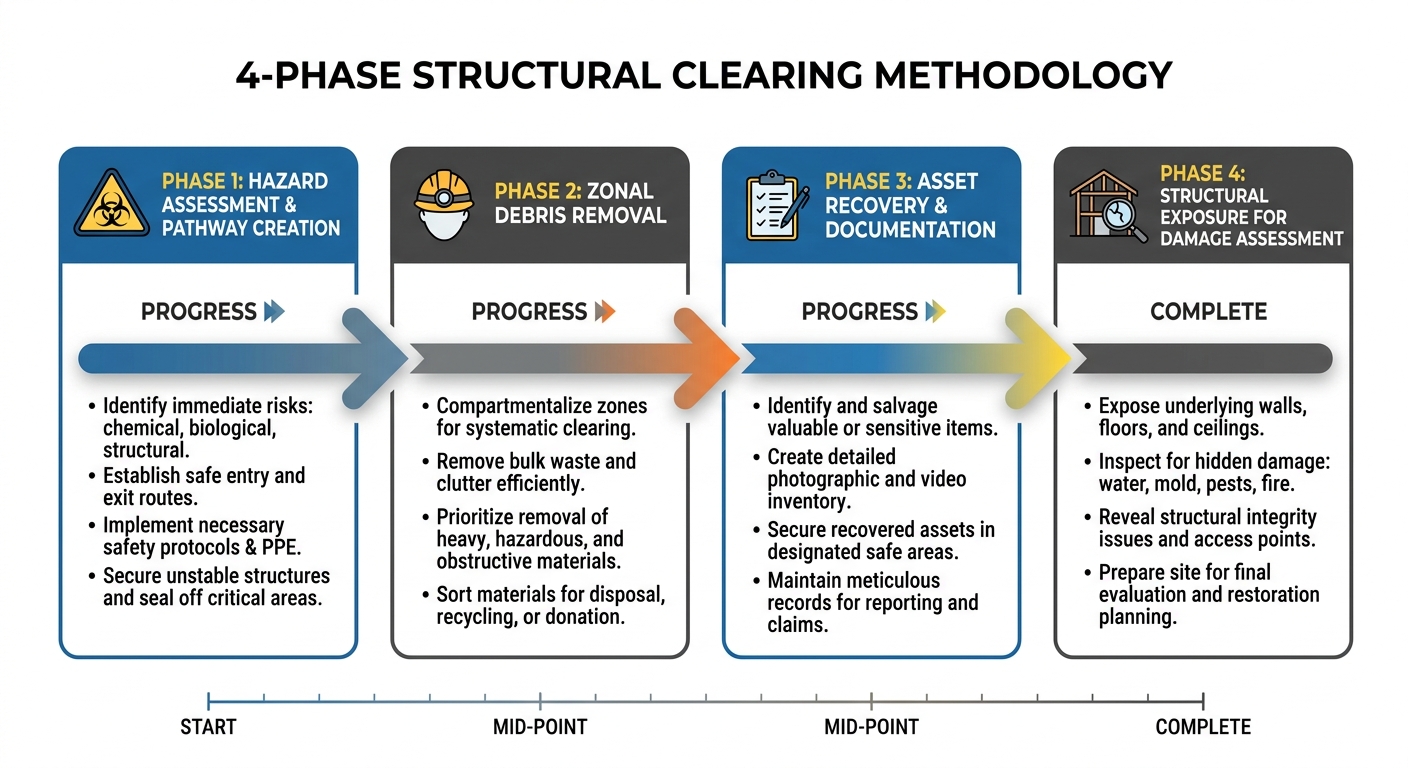
Phase 1: Hazard Assessment & Pathway Creation
Phase 1: Hazard Assessment & Pathway Creation establishes operational safety and enables subsequent clearing phases. Initial walkthrough identifies:
- Biohazards requiring containment
- Structural instability necessitating shoring or entry restrictions
- HHW concentrations requiring segregated handling
Clearing primary ingress and egress routes enables emergency personnel access, inspector access for damage assessment, and contractor access for remediation work. Establishing containment zones prevents cross-contamination during removal, particularly critical when dealing with airborne pathogens or toxic vapor emissions from decomposing organic matter.
This phase typically requires 2-4 hours for moderate hoarding scenarios and 6-8 hours for extreme cases where compacted debris blocks all pathways. The financial value lies in preventing worker injury claims and enabling rapid subsequent phases. Asset managers should expect detailed photographic documentation and preliminary hazard inventory at phase completion.
Phase 2: Zonal Debris Removal
Phase 2: Zonal Debris Removal implements systematic room-by-room clearing to expose structural elements. Load-bearing walls, flooring, plumbing, and electrical systems must be visually inspected for damage concealed by debris accumulation. Concurrent sorting into categories—general waste, recyclables, HHW, biohazards, and asset recovery items—ensures proper disposal routing and cost optimization.
Use of HEPA air scrubbers prevents mold spore and pathogen aerosolization during debris disturbance, protecting both workers and preventing HVAC system contamination that would require separate remediation. Wetted-down techniques using EPA-approved antimicrobial solutions reduce airborne particulate while beginning biological decontamination.
Phase 3: Asset Recovery & Documentation
Phase 3: Asset Recovery & Documentation addresses legal and financial recovery opportunities often overlooked in amateur cleanouts. This includes:
- Legal documents: Preventing costly title complications, particularly in probate holds where missing deeds or trust documents create months of legal delays
- Financial records: Tax returns, bank statements, and investment account documentation required for estate settlement or bankruptcy proceedings
- Valuables: Jewelry, coin collections, and antique items that represent both sentimental and monetary value
Photographic documentation of all stages serves multiple purposes: insurance claims requiring proof of property condition, legal defense in tenant disputes alleging property damage or theft, and property condition reports for investor or HUD reporting. This documentation isn’t ancillary—it’s core deliverable that protects institutional clients from subsequent litigation.
Phase 4: Structural Exposure for Damage Assessment
Phase 4: Structural Exposure for Damage Assessment represents the final clearing stage that enables property transition from distressed asset to marketable inventory. Complete removal of compacted debris exposes:
- Black mold colonies
- Water leaks from failed plumbing or roof damage
- Termite damage in load-bearing structures
- Foundation issues requiring engineering assessment
This exposure enables immediate access for structural engineers, mold remediation specialists, and general contractors, accelerating the property’s transition from discovery through remediation to market-ready status.
The financial impact of proper structural exposure extends beyond immediate savings. Properties cleared to bare structure enable accurate contractor bidding, eliminating change order disputes that inflate final remediation costs. Complete exposure reveals total damage scope upfront, preventing progressive discovery scenarios where contractors repeatedly expand scope and costs. For asset managers bound by quarterly performance metrics, accelerated timeline from acquisition through disposition directly impacts portfolio ROI.
Key Takeaways
For institutional asset managers and REO departments, an abandoned or severely hoarded property represents a critical decision point: act decisively with specialized resources, or watch holding costs compound while regulatory exposure increases.
The data is unambiguous. With 357,000+ annual foreclosure filings, millions of eviction proceedings, and up to 6% of properties potentially affected by hoarding behaviors, extreme cleanouts have become a standard operational challenge—not an outlier scenario. Traditional junk removal services lack the training, equipment, and regulatory compliance frameworks to handle these high-stakes property recoveries safely and legally.
Specialized cleanout services function as risk mitigation partners, not just vendors. They protect your institution from EPA penalties through proper hazardous waste routing, OSHA violations through bloodborne pathogen protocols, and HUD non-compliance through documented timeline adherence—all while accelerating the asset’s return to marketable condition. The initial investment in professional structural clearing consistently proves more cost-effective than the compounding financial drain of delayed recovery.
The strategic imperative for high-volume asset management: Speed and compliance aren’t competing priorities—they’re complementary imperatives. Every day a foreclosed property sits uncleared represents lost revenue, increasing remediation costs, and growing regulatory exposure. Deploying specialized property recovery services upfront isn’t a premium expense; it’s a fiduciary optimization that protects institutional capital while accelerating portfolio performance.
Ready to Accelerate Your Property Recovery Timeline?
Don’t let distressed properties drain your portfolio performance. Get a rapid assessment and timeline proposal tailored to institutional asset management requirements.
Contact Ballistic Junk Removal
Our specialized teams maintain full EPA, OSHA, and HUD compliance while delivering the accelerated timelines your portfolio demands.
References:
- ATTOM Data Solutions. (2024). Year-End 2023 U.S. Foreclosure Market Report. https://www.attomdata.com/news/market-trends/foreclosures/attom-year-end-2023-u-s-foreclosure-market-report/
- Eviction Lab at Princeton University. (2024). National Eviction Tracking System. https://evictionlab.org/eviction-tracking/
- American Psychiatric Association (APA). (2023). What is Hoarding Disorder? https://www.psychiatry.org/patients-families/hoarding-disorder/what-is-hoarding-disorder
- Occupational Safety and Health Administration (OSHA). (2024). Bloodborne Pathogens Standard 1910.1030. https://www.osha.gov/laws-regs/regulations/standardnumber/1910/1910.1030
- Environmental Protection Agency (EPA). (2024). Household Hazardous Waste (HHW). https://www.epa.gov/hw/household-hazardous-waste-hhw
- U.S. Department of Housing and Urban Development (HUD). (2024). Property Preservation and Protection Guidelines. https://www.hud.gov/program_offices/housing/sfh/nsc/presrv
- National Environmental Health Association (NEHA). (2021). Public Health Implications of Hoarding: Biohazards and Remediation. Journal of Environmental Health. https://www.neha.org/journal-environmental-health